
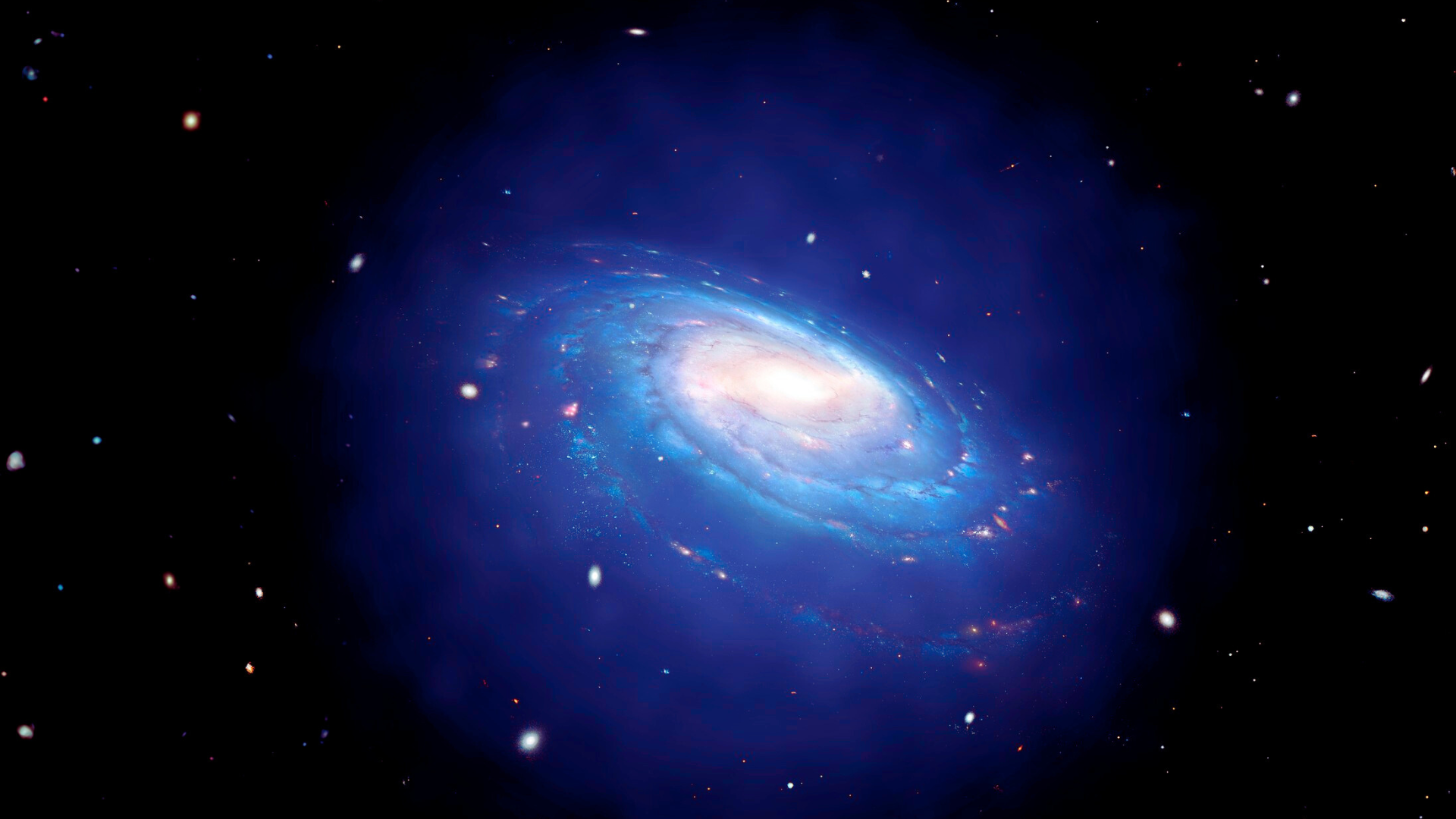
Dark matter is a fundamental component of the universe, comprising approximately 27% of its total mass. This elusive substance does not emit, absorb, or reflect light, making it nearly impossible to detect directly, yet its presence is inferred through its gravitational effects on visible matter. Astrophysicists study these effects to understand how galaxies form and behave, revealing a crucial aspect of the universe’s structure.
Despite its prevalence, dark matter remains one of the greatest mysteries in modern cosmology. Its properties and composition are still uncertain, leading to various theories and models in astrophysics. Understanding dark matter is essential not only for comprehending the formation of cosmic structures but also for unravelling the fundamental nature of the matter in space.
As research advances, the implications of dark matter extend beyond astronomy, challenging existing theories of physics and opening new avenues for inquiry. Engaging with this topic illuminates the profound complexities of the universe and highlights the gaps in current scientific knowledge.
Fundamentals of Dark Matter
Dark matter is a critical component of the universe, influencing structure formation and galaxy dynamics. Its elusive nature stems from its interaction with gravity rather than electromagnetic forces, making it invisible and detectable only through its gravitational effects.
Defining Dark Matter
Dark matter is a form of matter that does not emit, absorb, or reflect light, rendering it invisible to current astronomical instruments. It is estimated to constitute about 27% of the universe’s total mass-energy content. While it cannot be directly observed, its existence is inferred from the gravitational effects it has on visible matter, such as galaxies and galaxy clusters. The precise composition of dark matter remains unknown, with candidates including weakly interacting massive particles (WIMPs) and axions.
The Role of Dark Matter in the Cosmos
Dark matter plays a key role in the formation and evolution of galaxies and large-scale structures. Without dark matter, galaxies would not have the necessary gravitational pull to hold them together. Observations, such as the rotation curves of galaxies, indicate that visible matter alone cannot account for the observed gravitational forces. This discrepancy leads to the conclusion that dark matter is essential for understanding the structure of the cosmos.
Interaction with Gravity and Visible Matter
Dark matter interacts with gravity, influencing the motion of galaxies and galaxy clusters. Its gravitational field alters the trajectories of stars and gas within galaxies, ensuring their stability. Furthermore, dark matter affects the large-scale structure of the universe by helping to shape the cosmic web—regions of dense matter are connected by filaments of dark matter. In this way, it acts as a scaffolding, guiding the formation of visible matter.
Differences Between Dark Matter and Dark Energy
While dark matter contributes to the mass and structure of the universe, dark energy is responsible for its accelerated expansion. Dark matter exerts a gravitational pull, whereas dark energy has a repulsive effect. This distinction is crucial for cosmological models. Dark matter and dark energy together comprise approximately 95% of the universe, with dark matter being mass-based and dark energy related to the fabric of space itself. Understanding these differences helps clarify their respective roles in the cosmos.
Observational Evidence and Research
The exploration of dark matter rests heavily on a range of observational evidence and ongoing research. Key methodologies include gravitational lensing, galactic observations, and focused studies of notable cosmic phenomena, contributing to the understanding of dark matter’s role in the universe.
Gravitational Lensing and Galactic Observations
Gravitational lensing occurs when the gravity of massive objects, such as galaxy clusters, bends the light from more distant galaxies. This effect allows astronomers to map the distribution of mass, including dark matter.
Observations from the Hubble Space Telescope and the James Webb Space Telescope have revealed numerous instances of gravitational lensing. These observations provide crucial evidence for dark matter, demonstrating that the mass causing the lensing often exceeds what is visible in stars and gas. The Sloan Digital Sky Survey offers extensive data, enhancing understanding of galaxy structures and dark matter distribution.
The Bullet Cluster and Cosmic Microwave Background
The Bullet Cluster presents a striking example of dark matter’s existence. This galaxy cluster consists of two colliding clusters, with observable matter separated from the bulk of gravitational mass. X-ray observations from the Chandra X-ray Observatory confirmed the presence of hot gas, while gravitational lensing techniques demonstrated additional mass not associated with visible matter.
Studies of the cosmic microwave background (CMB) also support dark matter theories. The CMB provides a snapshot of the universe shortly after the Big Bang. Variations in temperature across the CMB reveal density fluctuations, attributed to dark matter’s influence on the universe’s evolution. This data aligns with the predictions of models incorporating dark matter.
Pioneering Work of Fritz Zwicky and Vera Rubin
Fritz Zwicky was instrumental in formulating the existence of dark matter during the 1930s. He examined the movement of galaxies within the Coma Cluster and noted that their velocities were too high for the visible mass to account for their gravitational cohesion.
Vera Rubin later expanded on this work in the 1970s. She studied galaxy rotation curves, discovering that outer stars orbit at unexpectedly high speeds, inconsistent with the gravitational pull from visible stars alone. Her findings bolstered the argument for dark matter, demonstrating that significant unseen mass must exist in galaxies.
Advances in Technology and Telescopes
Technological advancements have been crucial in dark matter research. The Hubble Space Telescope has provided high-resolution images of distant galaxies, allowing for detailed studies of lensing and distribution.
The James Webb Space Telescope, launched in late 2021, will enhance infrared observations, offering a new perspective on galaxy formation and the role of dark matter. Improvements in instruments like the Chandra X-ray Observatory enable finer analysis of hot gas in clusters, further supporting dark matter evidence.
Additionally, massive surveys and sky mapping initiatives, such as the Sloan Digital Sky Survey, continue to gather crucial data on galactic structures, contributing significantly to the understanding of dark matter’s distribution across the universe.
Theoretical Models and Particle Candidates
The exploration of theoretical models and particle candidates is central to comprehending dark matter. Researchers focus on a range of hypotheses, from specific particles to alternative theories that might reshape existing physics. The following subsections outline the most significant theoretical candidates and the key concepts surrounding them.
Weakly Interacting Massive Particles (WIMPs)
WIMPs are among the leading candidates for dark matter. They are proposed as massive particles that interact via weak nuclear force, making them elusive and difficult to detect.
Predictions suggest WIMPs might be produced in environments like the Large Hadron Collider, potentially linked to physics beyond the Standard Model. Detecting WIMPs involves sophisticated particle detectors capable of identifying rare interactions.
The current sensitivity of these detectors is enhancing as technology advances. Some experimental results are approaching the mass and interaction thresholds theorised for WIMPs, making detection increasingly feasible.
Axions and Sterile Neutrinos
Axions are hypothetical elementary particles that arise from certain theories explaining the strong force. They are extremely lightweight and, like WIMPs, would interact very weakly with ordinary matter.
Sterile neutrinos, another candidate, are a proposed type of neutrino that does not interact via the Standard Model forces. Their existence could provide insights into dark matter and lead to observations of new physics phenomena.
Both axions and sterile neutrinos suggest alternative paradigms for dark matter and have implications for astrophysical observations. Experimental efforts are underway to try to detect these particles directly or through their effects on cosmic structures.
Modified Newtonian Dynamics (MOND)
MOND represents a different approach, proposing modifications to Newton’s laws of motion at low accelerations, rather than introducing new particles. This theory was developed to address discrepancies in galactic rotation curves without invoking dark matter.
Advocates of MOND argue that it aligns closely with observational data in many cases. Critics, however, highlight its inability to fully account for gravitational lensing or the cosmic microwave background observations.
Efforts to reconcile MOND with general relativity continue, leading to ongoing debates within the astrophysical community. Such theories could significantly alter our comprehension of gravity and cosmic structure formation.
Astrophysical Constraints and Cosmological Implications
Astrophysical constraints are essential for shaping theories around dark matter. Observations of galaxy clusters, cosmic microwave background fluctuations, and large-scale structures provide critical data.
These observations impose limits on particle masses and interaction cross-sections of potential dark matter candidates. For example, results from NASA’s missions have provided vital insights into the distribution of dark matter in galaxies.
Understanding the nature of dark matter is crucial for cosmology, as it influences the evolution of the universe. The relationship between dark matter theories and other aspects of physics remains a vibrant area of research.
The Impact of Dark Matter on Cosmic Evolution
Dark matter plays a crucial role in shaping the universe’s structure and its developmental trajectory. Its influence is observed in the formation of galaxies, the dynamics of cosmic expansion, and its interconnectedness with other cosmic phenomena.
Galaxy Formation and the Large-Scale Structure
Dark matter is fundamental to galaxy formation. It acts as a gravitational anchor, facilitating the coalescence of baryonic matter into the first galaxies. This process creates the intricate cosmic web, where dark matter halos provide the framework for visible matter to aggregate.
The interaction between dark matter and baryonic matter allows for the formation of various cosmic structures. Galaxy clusters form in regions of higher dark matter density, leading to a large-scale structure that reflects the distribution of dark matter across the universe.
Influence on Accelerated Cosmic Expansion
Recent observations indicate that dark energy, coupled with dark matter, drives the accelerated expansion of the universe. The cosmological constant, a key parameter in the equations of general relativity, describes the energy density of empty space, influencing cosmic dynamics.
Dark matter’s gravitational effects counterbalance this expansion to some extent. While dark energy pushes galaxies apart, dark matter contributes to their formation, creating a complex interplay in the evolution of the universe. This relationship is vital for understanding how cosmic structures evolve over billions of years.
Dark Matter as the Universe’s Invisible Scaffold
As the universe expanded, dark matter served as an invisible scaffold, shaping the gravitational landscape. Its presence influences how galaxies and galaxy clusters form and interact. This scaffolding nature allows for intricate structures, including filaments and voids, forming a dynamic cosmic architecture.
Without dark matter, the current arrangement of galaxies would be markedly different. The gravitational grip of dark matter not only retains galaxies within clusters but also influences their movement across the cosmic expanse, underscoring its integral role in cosmic evolution.
Interconnections with Other Cosmic Mysteries
Dark matter’s properties raise questions that intertwine with other cosmic mysteries. For instance, the nature of dark energy and its impact on cosmic expansion remains deeply linked to dark matter’s distribution and behaviour.
The Dark Energy Spectroscopic Instrument aims to unravel these connections by mapping the distribution of dark matter and dark energy across the universe. Insights gained from this research may reveal fundamental truths about the universe’s origin and ultimate destiny, reflecting the complex relationships among these entities.